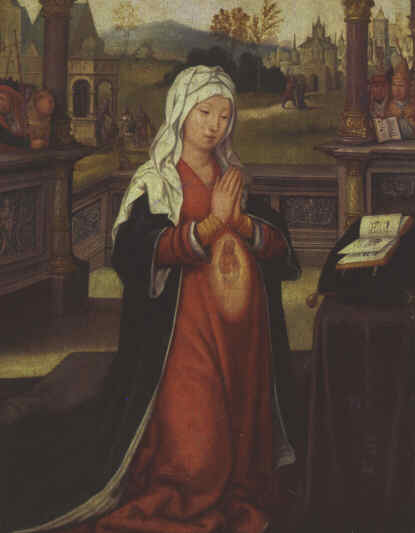
Story of St. Anne
St. Anne, Our Parish Namesake
Feast Day July 26
Anne (Hebrew, Hannah, grace; also spelled Ann, Anne, Anna) is the traditional name of the mother of the Blessed Virgin Mary.
All our information concerning the names and lives of Sts. Joachim and Anne, the parents of Mary, is derived from apocryphal literature, the Gospel of the Nativity of Mary, the Gospel of Pseudo-Matthew and the Protoevangelium of James. Though the earliest form of the latter, on which directly or indirectly the other two seem to be based, goes back to about A.D. 150, we can hardly accept as beyond doubt its various statements on its sole authority. In the Orient the Protoevangelium had great authority and portions of it were read on the feasts of Mary by the Greeks, Syrians, Copts, and Arabians. In the Occident, however, it was rejected by the Fathers of the Church until its contents were incorporated by Jacobus de Voragine in his "Golden Legend" in the thirteenth century. From that time on the story of St. Anne spread over the West and was amply developed, until St. Anne became one of the most popular saints also of the Latin Church.
The Protoevangelium gives the following account: In Nazareth there lived a rich and pious couple, Joachim and Hannah. They were childless. When on a feast day Joachim presented himself to offer sacrifice in the temple, he was repulsed by a certain Ruben, under the pretext that men without offspring were unworthy to be admitted. Whereupon Joachim, bowed down with grief, did not return home, but went into the mountains to make his plaint to God in solitude. Also Hannah, having learned the reason of the prolonged absence of her husband, cried to the Lord to take away from her the curse of sterility, promising to dedicate her child to the service of God. Their prayers were heard; an angel came to Hannah and said: "Hannah, the Lord has looked upon thy tears; thou shalt conceive and give birth and the fruit of thy womb shall be blessed by all the world". The angel made the same promise to Joachim, who returned to his wife. Hannah gave birth to a daughter whom she called Miriam (Mary).
The supposed relics of St. Anne were brought from the Holy Land to Constantinople in 710 and were still kept there in the church of St. Sophia in 1333. The tradition of the church of Apt in southern France pretends that the body of St. Anne was brought to Apt by St. Lazarus, the friend of Christ, was hidden by St. Auspicius (d. 398), and found again during the reign of Charlemagne (feast, Monday after the octave of Easter); these relics were brought to a magnificent chapel in 1664 (feast, 4 May). The head of St. Anne was kept at Mainz up to 1510, when it was stolen and brought to Düren in Rheinland. St. Anne is the patroness of Brittany. Her miraculous picture (feast, 7 March) is venerated at Notre Dame d'Auray, Diocese of Vannes. Also in Canada, where she is the principal patron of the province of Quebec, the shrine of St. Anne de Beaupré is well known. St. Anne is patroness of women in labour; she is represented holding the Blessed Virgin Mary in her lap, who again carries on her arm the child Jesus. She is also patroness of miners, Christ being compared to gold, Mary to silver.
(From New Advent)